casestudy, strategy, Strategy

Improve Digital Adoption

Digital Adoption

In today’s digitized era, insurance carriers recognize the pivotal role of digital tools in elevating the customer experience. However, a mere investment in these assets doesn’t guarantee success; their meaningful adoption is where the true value lies. Without a strategic focus on maximizing the utility and adoption of these digital assets, carriers risk underutilizing their investments, leading to diminished returns. To truly reap the benefits and enhance customer experience, insurance companies must actively drive the adoption of their digital offerings, ensuring that they are intuitive, user-centric, and seamlessly integrated into the customer journey.

Case Study

Client: A mid sized P&C insurance carrier had digital assets like online quote and bind, customer

Problem statement:

The question client was trying to answer – how do we improve digital adoption (enrolment in paperless and registration in customer portal) and increase customer digital engagement?

Client a had rolled out digital assets like paperless communication, customer portal for self service and was experiencing low adoption.

  • Low adoption of paperless leading to increased operational cost

−1 in 5 have enrolled to receive paperless billing

−1 in 16 have enrolled to receive paperless policy documents

−1 in 304 have enrolled to receive text

  • Less than 50% of Direct customers go on and register in customer portal after they buy a policy.
  • Very small % of non-online (agent channel) customers registered for customer portal.

Our Approach

Current state study/data collection
– Identify customer communications and state of paperless initiative
– Adoption data on paperless, customer portal
– Customer journey for paperless and portal registration
Analyze
– Identify system and process gaps
– Identify critical data needs/gaps
– Customer data analysis to identify customer segments and propensity
Synthesize recommendation
– Future state customer journeys with system impacts.
– Recommendation for addressing data gaps.
– Recommendations for approaches for different customer segments.
– Monitoring and segment based campaigns to educate customers on digital solutions
– Identified system and process changes to drive portal registration/adoption and paperless enrollment.

Technology Landscape

  • Guidewire (PC,BC, CC)
  • Customer portal – Angular, google analytics
  • DocuSign, Documaker (document generation) and Highland (document storage)

Results

  • Paperless adoption increased by 22% over one year.
  • In one year Customer portal registration for direct customer went up to 85%.
  • Customer portal registration for agent channel increased by 20%.
Read More
casestudy

Cloud Migration

Cloud Migration

Embracing cloud migration is pivotal for organizations striving to maintain relevance in today’s rapidly advancing digital era. Specifically, transitioning from on-premise solutions, like BizTalk, to the cloud not only offers enhanced flexibility but also aligns perfectly with AWS-powered digital stacks. This shift ensures seamless integration, optimizes operational efficiency, and accelerates speed to market. By leveraging the power of the cloud, businesses can adeptly navigate the challenges of modern commerce and harness the full potential of their technological investments.

Case Study

Client:A homeowners insurance carrier from West coast

Problem statement:

Client was trying to find a partner for the cloud migration.

The carrier used Biztalk for integrations.

  • Internal integrations like policy lookup, claims lookup etc.
  • External ternal integrations like credit score from 3rd party, MVR details from third party etc.

The customer also incurred significant licensing cost on an annual basis.

Biztalk looked out of place in the new enterprise vision for the technology – specifically with digital.

Our Approach

Discovery and blueprint
−Inventory of integration and complexity assessment (source and consumer)
−Identified key integrations patterns
−Design patterns with mapping to aws tech stack
−POC for identified design patterns
−Roadmap for migration
Delivery sprints over 6 months to deliver first 20 integrations.
Stop use of Biztalk by end of 9 months (all 28 integrations in production migrated to aws).
Created integration delivery PODs in collaboration with the customer.

Technology Landscape

    • aws API Gateway, Lambda.
    • Node JS.
    • Biztalk (during the analysis – decommissioned).

Results

  • Savings of close to $1M per year on Biztalk lic, maintenance staff (specific skill).
  • Consolidation of technology and skillset needed to support.
Read More
casestudy, strategy, Strategy

API Strategy

API Strategy

In the dynamic world of insurance, an effective API (Application Programming Interface) strategy stands as a linchpin for digital transformation and operational efficiency. By harnessing the power of APIs, insurance companies can seamlessly integrate disparate systems, from policy management to claims processing, facilitating real-time data exchange and automation. This not only streamlines internal workflows but also enhances customer experiences by offering tailored products, instant policy quotes, and rapid claim settlements. Moreover, with the proliferation of insurtech and digital platforms, APIs enable insurers to tap into innovative ecosystems, collaborate with third-party developers, and extend their offerings across multiple digital touchpoints. By doing so, they can cater to the evolving needs of modern policyholders, drive revenue growth through new channels, and stay ahead in the competitive landscape. In essence, a robust API strategy empowers insurance companies to be agile, data-driven, and customer-centric, setting the foundation for sustained success in the digital age.

Case Study

Client: A mid sized insurance carrier personal and small commercial focused, who sell their products through independent agents.

Problem statement:

Client was looking for rapid digital transformation and they realized that APIs often play a critical role in many functions of their business as an enabler for digital products and projects.

  • Limited agility in launching new insurance products.
  • Inefficient data exchange with partners, brokers, and third-party platforms.
  • Suboptimal customer experiences due to delays and lack of real-time service capabilities.
  • Increased operational costs and maintenance overheads.

Client was looking for a partner with expertise in technology and business to answer

How are insurers approaching APIs?

What insurers are doing with  the APIs?

What eco-systems are out there?

What should we be doing? What should be our technology? What should be internal and external APIs?

Our Approach

Current state study/data collection
– Understand current integration patterns and technology landscape.
– Understand overall business goals, technological challenges, and the potential value drivers of implementing an API strategy.
– Understand potential API consumers, both internal and external – needs and painpoints.
Analyze
– Identify strategic fit of API between business and IT context.
– Identify technologies that fit the need.
– Identify critical data needs/gaps
– Identify API ecosystems that could have potential.
– Understanding the competitive landscape, market trends, and best practices in API implementation.
Synthesize recommendation
– A detailed API strategy blueprint, highlighting the architecture, integration points, and technology stack recommendations.
– A roadmap for API implementation, prioritizing critical integration points and quick wins
– Guidelines for API security, governance, and lifecycle management to ensure data protection and regulatory compliance.Future state customer journeys with system impacts.

Technology Landscape

  • Guidewire (PC,BC, CC)
  • Customer portal – Angular
  • API gateway, Java / Node.JS backend

Results

  • Enhanced integration – seamless integrations – helping speed to market (and cost reduction) for launch of new experience and capabilities.
  • Innovation and agility – rapid experimentation of digital products.
Read More
casestudy, Strategy, strategy

Digital Roadmap

DIGITAL ROADMAP

The consumers are expecting high quality, personalized seamless experiences and services across all digital channels. With integrated approach to strategy and execution, we will help you to define the digital transformation roadmap and exceed your customer’s expectation.

Case Study

Client: A mid sized P&C insurance carrier had digital assets like online quote and bind, customer

Problem statement: Client wanted us to broadly answer two questions. What should be our strategy regarding mobile self-service capabilities? What should be our priorities?

Our Approach

We started with a Current state study. We Collected current customer portal usage pattern. We collected Competitor mobile apps and their capabilities. We got Customer feedback on competitor mobile apps.

Then we analyzed the data collected. Created a list of capabilities that customers are seeking from mobile by looking at traffic to customer portal from mobile. We did the analysis of competitor mobile features and analysis of customer feedbacks on mobile apps. Ended up with a comprehensive list key features and the needs for realizing them on a mobile app.  We established the customer need/demand from mobile apps from direct feedback and their frustrations with existing capabilities.

Finally we synthesized recommendation – which included many rounds of reviews and feedback. We created a Roadmap of features to be delivered with focus on key capabilities desired by the customer and internal capabilities to deliver that successfully. We also worked on technology selection and architecture.

Technology landscape included Guidewire, APIs built using Java, Mobile app built using Flutter for iOS/android.

Results

We delivered a Mobile roadmap for 15 months – with first release in 6 months for table-stake features.

The benefits were enormous. JD Powers recognized the insurer as number one in digital  experience 6 months after the mobile app release. Customer satisfaction score improved 40%. The mobile application was rated 4.9 and one of the best insurance apps (limited features but works what it promises).

All this was achieved in 6 months from the start of kickoff of the strategic engagement with acxhange.

At axhange we value innovation, collaboration, integrity, and a relentless commitment to client success.

Read More
casestudy

DuckCreek Delivery Squad

DuckCreek Development

In today’s dynamic insurance landscape, insurers are recognizing the imperative to evolve and adapt. Transitioning to modern core platforms, like DuckCreek, has become a strategic priority for many. These advanced systems not only facilitate rapid product launches but also ensure enhanced flexibility and rigorous compliance adherence. By investing in such cutting-edge solutions, insurance companies position themselves at the forefront of innovation, streamlining operations and delivering unparalleled customer experiences.

Case Study

Client:A homeowners insurance carrier from West coast

Problem statement:

Client was looking for a partner who can build a strong Duckcreek competency.

The client has a legacy policy administration on AS400. They also have an older version of Duckcreek (relic from previous attempt to modernize) with a small book of business. The client wanted to rollout some of the biggest books to Duckcreek 7.2 which can be used as base product as they migrate rest of the book.

The client was not happy with the existing partners who had worked on earlier modernization efforts. Specifically – client was looking for,

  • A partner who can build a strong offshore team that his team can directly work with.
  • A partner who understands their business and can engage at appropriate levels while they are on their transformation journey.

Our Approach

– Identified gaps in skills for the team.
– Senior leadership spent time to understand the architecture, current challenges and roadmap.
– Established benchmark goals for us (customer and acxhange) to be successful
– Started with one pod – ramped up a team in collaboration with customer that was deployed over 3 months time
– Mixture of internal and lateral recruitment.
– Addressed specific HO insurance knowledge gaps through training
– Setup governance structure that helped us monitor progress and ability to take corrective actions.

Technology Landscape

    • DuckCreek 7.2

Results

  • Go-live achieved for a major state on time and under budget
  • Speed to market and quality goals measured achieved.
Read More
casestudy

Fullstack delivery pod

Fullstack Digital Engineering Pod

In the digital era, insurance companies are keenly aware of the pivotal role agents play in fostering strong customer relationships. To empower these agents, many insurers are investing in state-of-the-art agent portals, a testament to their commitment to enhancing the agent experience. These portals, equipped with modern digital capabilities, serve as a one-stop hub, streamlining processes and providing real-time data access. By offering tools that simplify and enhance tasks, insurers not only boost agent productivity but also ensure that agents can provide customers with swift and personalized service, setting a new benchmark in the industry.

Case Study

Client: Client a niche homeowner insurance carrier focused on West coast market who sell their products through independent agents.

Problem statement:

The customer was looking at Increased ease of doing business for agents using a modern technology platform that is easy to maintain.

  • The developed product was not meeting the quality and there was a need for speed to market.
  • The client had challenges having a balanced team (onsite/offshore) that has knowledge of insurance and competent in the relevant technology from existing vendors.

Our Approach

– Analysis of the proposed architecture and key challenges
– Identified key skills required
– Established benchmark goals for us (customer and acxhange) to be successful
– Setup governance structure that helped us monitor progress and ability to take corrective actions.
– Ramped up a team and built pods in collaboration with customer that was deployed in 2 months time
– Mixture of internal and lateral recruitment.
– Addressed domain knowledge gaps through training
– Address technology gaps through training to develop fullstack engineers.
– Improved DevOps pipelines to automate deployments
– Improved code quality through changes in architecture choices and leveraging tools.

Technology Landscape

    • Angular 11 frontend
    • API gateway, Java / Node.JS backend
    • DynamoDB
    • DuckCreek 7.2

Results

  • Go-live achieved for one major state on time and under budget ; Biggest state will be live on the platform in 6 months.
  • Speed to market and quality goals measured achieved.
Read More
casestudy, strategy, Strategy

Payments Processing Transformation

Payments Processing Transformation

Payment processing plays a pivotal role in the insurance sector, especially crucial in today’s digital era where the expectation is for instant, secure, and flawless transactions. Effective payment processing systems ensure prompt and precise collection of premiums and expedite the settlement of claims, thereby fostering trust and satisfaction among customers. In the digital space, this necessitates the integration of payment gateways, the automation of reconciliation processes, and the secure handling of sensitive financial information, all contributing to a seamless customer journey. Additionally, digital payment processing allows insurance companies to gather and scrutinize transaction data, offering insights for enhanced operational efficiency.

Case Study

Client: A mid sized personal lines insurance carrier.

Problem statement:

The client had multiple Policy (6), Billing (5) and Payment (8) systems. Client ended up having these many systems due to various mergers and acquisitions and in the midst of transforming their policy and billing systems to next gen systems.  This complex environment resulted in complex integrations for payment processing and multitude challenges such as

  • Inability to reconcile
  • Lack of audit controls
  • Payment transaction used to hop through multiple intermediate systems
  • Resulted in poor customer experience (inconsistent and inaccurate billing information, duplicate payments, dropped/missing payments, delay in posting payments to billing system, etc.)
  • PCI compliance challenges
  • Intermediate MS Access & Excel based solutions to support payment processes and reporting

Client were looking for a partner to help transform their payment processing with following objectives:

  • Simplify payment processing
  • PCI compliant
  • Enable audit controls
  • Reduce back office operational processes (manual processes with sizable team)

    Our Approach

    Current state analysis
    – We performed a detailed analysis to understand current state challenges and documented.
    – Detailed integration document that mapped what type of payments are processed by which system and how those payments are posted to billing system.
    Design and Implementation
    – Designed payment journey that provided detailed mapping of insured’s payment journey across payment channels and payment types.
    – We ramped up team and implemented a modular payment system (Bill due lookup, payment processor, vault for CC & accounts, recurring payments, wallet, reconciliation, suspense, etc.)
    – The solution also streamlined financial & GL reporting
    – We delivered the solution in 2 phases with first phase with core capabilities implemented in under 7 months (phase 1) and phase 2 in 4 months.

    Technology Landscape

    Backend REST APIs built using Java/JEE Spring framework, Batch interfaces built using Informatica, with MS SQL Server as database, Angular as the front end technology, observability using Dynatrace, end-to-end encryption at rest and in transit

    Results

    • PCI Compliance (with flying colors)
    • Clear and concise auditability
    • Improved customer experience & service NPS
    • Reduced overall spend by $2M per year
    • Repurposed back office operations team to focus on other key policy & claims functions
    • ROI in under two years
    • A centralized solution that processes USD 4.5 Billion in premium payments
    Read More
    casestudy, Strategy, strategy

    Sourcing Strategy and Cost Optimization

    Sourcing Strategy

    For insurance companies operating in today’s highly competitive environment, an effective sourcing strategy is paramount to ensure sustainable growth and profitability. An astute sourcing strategy helps insurers delineate between roles that are core to their business, which should be insourced, and those that can be outsourced for better efficiency and cost structures. Furthermore, by considering offshoring for specific roles or tasks, companies can tap into global talent pools and leverage cost advantages inherent in certain geographies. This strategic decision-making not only optimizes overall operational costs but also ensures that the company retains critical competencies in-house while leveraging external expertise for enhanced scalability and agility.

    Case Study

    Client: A mid sized P&C insurance carrier had digital assets like online quote and bind, customer

    Problem statement:

    Client wanted us to broadly answer three questions.

    1.What areas/skills I should insource vs outsource?

    2.How can I reduce overall cost?

    3.Should I offshore? What work/roles I should offshore?

    Client had relationship with one global vendor for a long time. Recently started engaging other vendors. CIO had a mandate to reduce expense and improve quality and speed to market.

    Our Approach

    Current state analysis
    – Current landscape from the perspective of people, process, technology and initiatives
    – Business strategy and IT strategy
    – Feedback and challenges from the customer on the vendor (reviewed internal scoring)
    – Collected all the spend data for IT – details at the level of person, role, vendor, rate, engagement/project
    Analyze
    – Compared vendor rates to industry benchmarks
    – Models and options for sourcing with cost and benefits view
    – Core vs context and identified key roles
    – Identified key features and the needs for realizing them on a mobile app.
    Recommendations
    – Alignment on the strategy and documenting final recommendation
    – Strategies for vendor negotiation.
    – Helped negotiate a win-win deal between the largest vendor and the client.
    – Identified key roles that was insourced.
    – Identified key roles that was context and moved to offshore.

    Results

    • Reduced vendor cost by $3M annual based on rate reductions.
    • Pushed work that was non-core to offshore and helped reduce overall IT spend.
    • Improved ratio of employee vs contractor that helped retain knowledge.
    Read More
    Blog

    Generative AI in insurance

    There is a lot of buzz around Generative AI/Large Language models (LLM) due to ChatGPT, and in this article we will discuss some use cases in the insurance industry and some of the work we have done at acxhange. In this article we will use ChatGPT or LLM interchangeably.

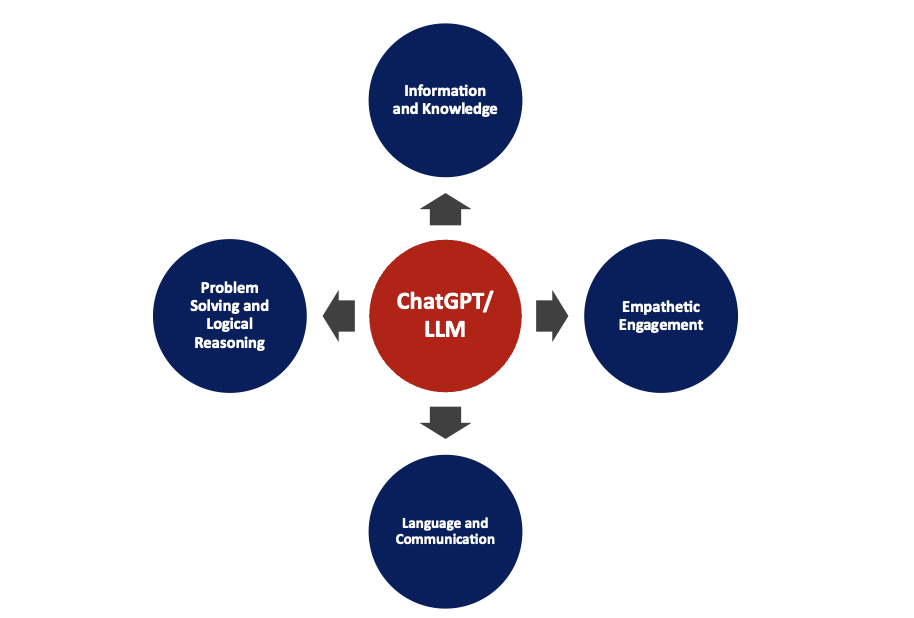
    At a high level, ChatGPT (or LLM or Model) can help with the following broad areas.

    Information and Knowledge: ChatGPT has been trained on a vast amount of information and can assist with answering questions, providing explanations, and offering insights across various subjects such as science, history, geography, technology, and more. ChatGPT can help you find specific details or offer general knowledge on a wide range of topics.

    Language and Communication: ChatGPT can help with tasks related to language understanding, generation, and translation. Whether you need help in writing, proofreading, or coming up with creative ideas, ChatGPT can provide suggestions and guidance. ChatGPT can also help with grammar, vocabulary, and structuring sentences or documents.

    Problem Solving and Logical Reasoning: ChatGPT can engage in logical reasoning, critical thinking, and problem-solving discussions. If you need assistance in analyzing a situation, exploring different perspectives, or evaluating potential solutions, ChatGPT can help guide you through the process.

    Empathetic Engagement: While ChatGPT is an artificial intelligence and lack emotions, it can still offer support and engage in empathetic conversations. It can provide a listening ear, offer advice, and help you explore your thoughts and feelings. However, it’s important to note that It is not a substitute for professional help, and if you require assistance with serious emotional or mental health issues, it is recommended to reach out to a qualified human professional.

    ChatGPT can be applied in various ways within the insurance industry to enhance customer service, streamline processes, and improve efficiency. Below few potential applications across insurance value chain. 

    Marketing and sales: ChatGPT can revolutionize marketing and sales in insurance by providing personalized customer interactions, automating lead generation & qualification, and help craft targeted campaigns. Its natural language processing capabilities enable tailored insurance recommendations and prompt responses to inquiries. Analyzing customer data helping identify upselling opportunities, while content creation and social media engagement can enhance brand reach. ChatGPT can be used to automate and streamline processes to boost customer engagement, and drive business growth in the insurance industry.

    Customer Support: ChatGPT can be used as a virtual assistant to handle customer inquiries, provide information about policies and coverage, and assist with common customer service tasks. It can answer frequently asked questions, guide customers through claims processes, and offer support in a conversational manner, providing a more efficient and personalized customer experience.

    Claims Processing: ChatGPT can help automate parts of the claims processing workflow. By analyzing claim details provided by customers, it can assist in gathering relevant information, verifying policy coverage, and estimating claim amounts. This can expedite the claims process and reduce the need for manual intervention, improving overall efficiency.

    Underwriting and Risk Assessment: ChatGPT can assist underwriters by analyzing and interpreting data from insurance applications. It can help identify potential risks, assess policy eligibility, and provide recommendations based on historical data, policy guidelines, and industry regulations. This can streamline the underwriting process and improve decision-making.

    Policy Management: ChatGPT can be utilized to manage policy-related inquiries, such as policy modifications, renewals, and cancellations. It can assist customers in understanding their policy terms and conditions, provide premium quotes, and guide them through policy management tasks. This helps enhance self-service capabilities and reduces the workload on customer service agents.

    Information Technology: In the realm of Information Technology, ChatGPT proves invaluable for developers and testers, enabling code and script generation, aiding Technical Support with knowledge base creation, documentation, and streamlining routine IT Operations tasks.

    It’s important to note that while ChatGPT can automate certain aspects of insurance processes, human oversight and intervention are still necessary, particularly for complex or sensitive situations. Additionally, data security and privacy should be maintained when utilizing AI technologies in the insurance industry.

    Here at Acxhange, we have made significant strides in leveraging ChatGPT technology to develop cutting-edge solutions that are currently deployed in production. I am excited to share one such solution.

    In the insurance industry, the need to efficiently handle a wide variety of inbound documents on a daily basis is paramount. These documents encompass policy applications, claims forms, supporting materials like medical records or police reports, endorsements, renewals, cancellations, and various other correspondences related to insurance policies. They can arrive via emails, emails with attachments, faxes (yes, they still exist!), and scanned documents. The ability to process these documents accurately and swiftly is crucial for insurers as it directly affects their capacity to deliver prompt and precise services to customers.

    While OCR, RPA, and ML technologies have been employed to automate parts of the document processing pipeline, reducing errors and enhancing overall efficiency, a significant portion of the process still remains manual. Manual keying often leads to information loss, and even solutions using OCR, RPA, and ML have fallen short of fully eliminating the need for manual effort.

    To address these challenges, we harnessed the capabilities of ChatGPT in language understanding, communication, problem-solving, and logical reasoning. The result is a robust solution that effectively tackles this problem with a higher degree of success. Our solution automates the processing of inbound documents and ensures data integrity, eliminating the loss of valuable information. Moreover, it extracts meaningful insights from these documents, leading to improved experiences for customers, intermediaries, partners, and employees.

    By combining the power of ChatGPT with advanced document processing techniques, we have revolutionized the way insurers handle their inbound documents. Our solution enhances efficiency, accuracy, and customer satisfaction by streamlining operations, reducing manual effort, and enabling valuable insights from the data contained within the documents.

    We are excited to bring this innovative solution to our clients and empower them to transform their document processing workflows for the better.

     

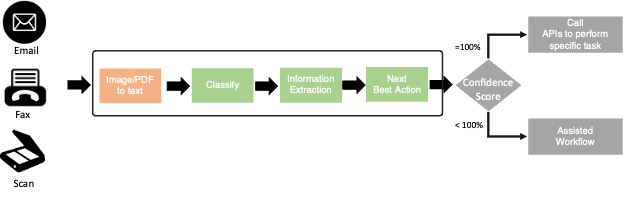
    The architecture includes use of orchestration engine, and we leveraged Microsoft Azure OpenAI service for LLM capabilities which has built-in security and enterprise scalability.  The acxhange solution comprises of multiple components that facilitate the end-to-end processing of incoming documents.

    1. The “Image/PDF to text” component serves as the inbox for all incoming documents, converting image-based PDFs into text format for further processing.
    2. The “Classify” component utilizes the power of ChatGPT to extract relevant information from the documents and classify them into different categories or buckets based on their content.
    3. The “Information Extraction” component handles the second-level extraction, which is tailored to the specific document type. This step focuses on extracting detailed information that is unique to each document category.
    4. Leveraging the extracted content and designed prompts, we enable the system to take the “next best” action. This decision is based on confidence scores, allowing for the implementation of a fully automated workflow or an assisted workflow that involves human intervention.

    With our cutting-edge solution powered by Microsoft Azure OpenAI Service, we’ve achieved outstanding outcomes for a West Coast-based client, significantly alleviating their operations team’s workload. Witnessing a remarkable 100% classification accuracy, our system ensures precise categorization of documents. By seamlessly implementing automated next best actions, we’ve streamlined their work process, leading to an impressive 60% reduction in processing efforts for complex cases like application submissions, cancelations etc. Our solution efficiently handles these tasks through a seamless automated flow, enhancing overall efficiency and productivity.

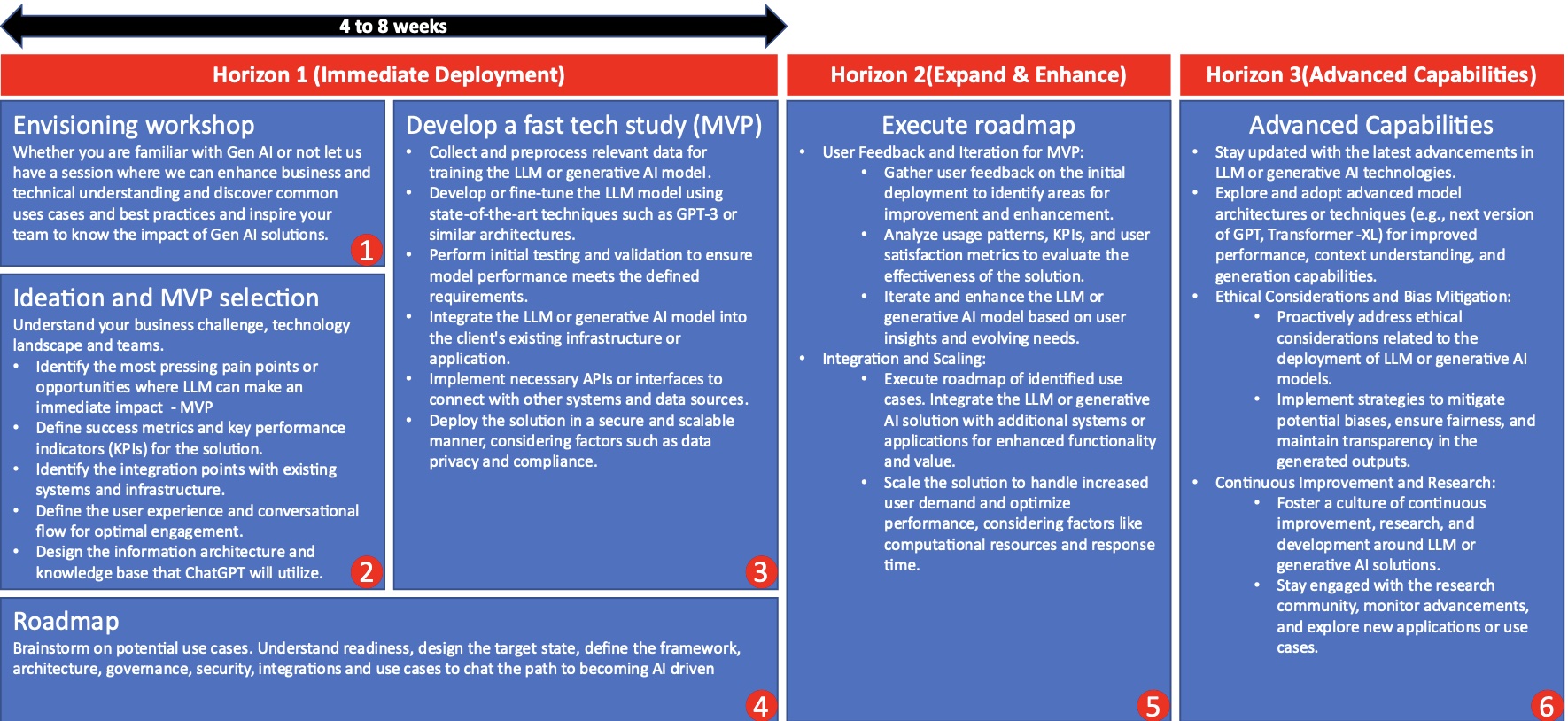
    We are committed to delivering tangible results quickly, prioritizing your productivity improvement in a matter of weeks, not months. Our accelerated approach is designed to provide a seamless and efficient transition to Generative AI, offering numerous benefits along the way. Below outline of our approach, which will lead you on a transformative journey towards enhanced efficiency and streamlined processing, reaping rewarding outcomes at each stage.

    Our approach is designed to expedite your journey into the world of Generative AI, unlocking its rewards and benefits swiftly. Let us be your trusted guide as we embark on this transformative endeavor together, increasing your efficiency, productivity, and overall operational excellence. If you have any questions, please reach out to us.

    Get in Touch

    We're here to answer all your queries. Reach out to us to accelerate your business

    Read More
    Blog

    Digital First Notice Of Loss

    The First Notice of Loss (FNOL) is a critical touchpoint in the insurance customer journey. It’s often the first interaction a policyholder has with their insurer after an incident, and their experience during this process can significantly impact their overall perception of the insurer. In today’s digital age, insurers have an opportunity to revolutionize the FNOL process, making it more customer-centric, efficient, and effective.

    A digital FNOL process can be designed to offer customers an intuitive, easy-to-use platform where they can report incidents quickly and accurately. This platform, typically accessible via a mobile app or online portal, should guide customers through the reporting process, prompting them to provide essential information about the incident. It should also allow them to upload relevant documents, photos or videos directly, significantly reducing the need for follow-up communications and speeding up the claims process.

    AI-powered chatbots can enhance the digital FNOL experience by providing real-time assistance to customers as they navigate the reporting process. These virtual assistants can answer common queries, clarify doubts, and provide reassurances, ensuring that customers feel supported throughout.

    The digital platform should also allow customers to track the progress of their claims in real-time. Transparent updates on claim status, next steps, and estimated timelines can go a long way in assuaging customer anxiety during what can be a stressful time.

    Integrating telematics data can further refine the digital FNOL process for auto insurance claims. With customer consent, insurers can access real-time data from connected vehicles, gaining immediate, accurate insights into the incident. This can streamline the claims process and potentially expedite settlements.

    From the insurer’s perspective, a digital FNOL process can automate claim routing based on the type and complexity of the claim. Simpler claims can be fast-tracked through an automated process, while complex claims are directed to human adjusters for more detailed investigation. This improves operational efficiency and allows adjusters to focus their efforts where they are most needed.

    Data security and privacy should be paramount in the design of the digital FNOL process. Robust encryption and stringent data handling protocols should be implemented to protect sensitive customer data.

    In conclusion, a well-designed digital FNOL process can provide customers with a seamless, efficient, and supportive experience during a stressful time. By adopting digital technologies and putting the customer at the center of the FNOL process, insurers can improve customer satisfaction, streamline operations, and differentiate themselves in an increasingly competitive market.

    Get in Touch

    We're here to answer all your queries. Reach out to us to accelerate your business

    Read More