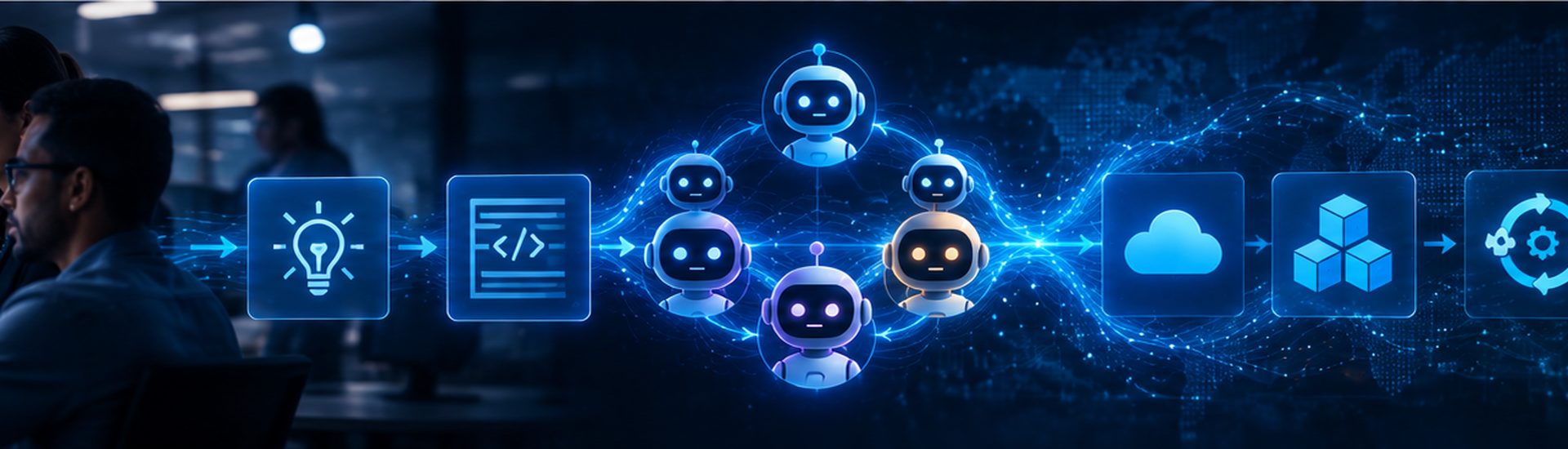

Illustration generated using ChatGPT
You have seen this movie before – if you have been in enterprise technology long enough, this pattern will feel familiar. Twenty-five years ago, critical business processes (often) lived in Microsoft Access databases, Excel spreadsheets, or applications running under someone’s desk. Individual teams built solutions to solve immediate business problems, and many of them were remarkably effective. Over time, however, those isolated solutions became difficult to secure, impossible to inventory, and risky to maintain. Organizations responded by introducing enterprise architecture, application portfolios, governance, and standardized platforms. Today, AI agents are following a similar trajectory. Employees can build powerful agents on their desktops in hours, connecting them to corporate data, APIs, and business processes. Individually, these agents may deliver significant value. Collectively, without visibility and governance, they risk becoming the next generation of shadow IT.
That experience fundamentally changed how enterprises governed technology. For years, enterprise governance focused on systems, applications, APIs, and data. Organizations built inventories of applications and databases, documented APIs, classified sensitive data, implemented identity and access management, and established cybersecurity controls. These practices became standard because every enterprise eventually needed to answer a simple set of questions.
- What is running inside our organization?
- What business purpose does it serve?
- Who owns and is accountable for it?
Artificial Intelligence is introducing an entirely new class of enterprise assets – Not models – Not prompts – Agents. And sooner than many organizations expect, auditors, regulators, security teams, and executive leadership will begin asking a new question. “Show me every AI agent currently operating in your enterprise, what it has access to, what decisions it makes, and who is accountable for it.”
The Rise of Enterprise Agents
Unlike traditional software, AI agents are no longer passive tools waiting for user input. Modern agents can:
- Access enterprise applications
- Retrieve information from multiple systems
- Execute workflows
- Generate recommendations
- Invoke APIs
- Communicate with other agents
- Trigger business actions
- Learn from prior interactions
- In many organizations, dozens – or eventually hundreds – of agents will operate simultaneously across business functions. Each with different permissions, responsibilities, and business impact.

Governance Is Becoming the Real Challenge
Today’s AI conversation focuses heavily on model selection and prompt engineering. Those are important. But they are not the long-term governance problem. The governance challenge is operational. Imagine being asked following questions.
- Which agents currently exist?
- Which business processes do they participate in?
- Which systems can they access?
- Which APIs can they invoke?
- Which decisions require human approval?
- Which version of the prompt is running?
- Which model is each agent using?
- Which data sources ground its responses?
- Which regulations apply?
- Who owns the agent?
- When was it last evaluated?
Many organizations cannot answer those questions today – not because they lack technology, but because they lack governance.
AI Agents Will Become Enterprise Assets
Just as APIs became managed enterprise assets, AI agents will require lifecycle management. Organizations will need to maintain an inventory that captures below information.
- Agent identity and ownership
- Business purpose
- Model(s) used
- Prompt versions
- Tools and APIs available
- Connected enterprise systems
- Data access permissions
- Human approval requirements
- Risk classification
- Performance metrics
- Operational status
- Audit history
Without this visibility, enterprises will struggle to manage operational risk, security, compliance, and change.
Regulation Is Already Moving in This Direction
While today’s regulations may not explicitly require an “AI agent inventory,” the direction is clear. Frameworks such as the NIST AI Risk Management Framework, ISO/IEC 42001, and the EU AI Act emphasize governance, accountability, transparency, lifecycle management, and human oversight. Internal audit teams and regulators are increasingly focused on understanding how AI systems are deployed, monitored, and controlled. As organizations transition from isolated AI models to autonomous agents capable of executing work, those governance expectations will naturally extend to the agents themselves. The question is no longer whether organizations should govern AI. The question is how they will govern hundreds of autonomous AI workers operating across the enterprise.
AgentOps Is the New DevOps
Organizations invested heavily over the past decade in DevOps, CloudOps, DataOps, and MLOps. The next operational discipline is emerging: AgentOps. AgentOps extends beyond model monitoring to encompass the operational management of autonomous agents throughout their lifecycle – from deployment and configuration to monitoring, evaluation, governance, and retirement. It provides the visibility required to answer fundamental operational questions like below.
- Is the agent performing as expected?
- Is it using approved tools?
- Is it following business policy?
- Has its behavior changed?
- Can we explain its decisions?
- Can we audit every action it performed?
Without AgentOps, organizations risk creating an environment where AI agents multiply faster than governance can keep pace.
Preparing Today Prevents Tomorrow’s Audit Findings
Most organizations are still experimenting with AI. That is exactly why governance should begin now. Establishing standards before hundreds of agents exist is dramatically easier than retrofitting governance later. Forward-looking organizations are already thinking beyond individual AI use cases and asking broader architectural questions.
- How should agents be designed?
- How are they approved?
- How are they monitored?
- How do they integrate with enterprise systems?
- How do we measure value?
- How do we ensure accountability?
The enterprises that answer those questions today will be significantly better positioned as AI adoption accelerates.
From AI Experiments to Governed Agentic Enterprises
At Acxhange, we believe the challenge isn’t simply building AI agents – it’s building an enterprise that can trust, govern, and scale them. That’s why we have invested in frameworks, engineering practices, and platforms that help organizations move from isolated AI experiments to enterprise-wide, governed agent ecosystems. Our StratWorks consulting framework helps organizations identify where agents create value, while our Agentic Engineering practice designs and builds enterprise-grade autonomous systems. Together with KognitiveWorks, our enterprise agentic platform, we help organizations move from isolated AI pilots to governed, scalable, and production-ready agent ecosystems. Because the future isn’t simply about building AI agents. It’s about knowing every agent that is running, understanding what it is doing, and proving that it is operating responsibly.
If you are beginning to think about questions like “How many AI agents do we already have?”, “Who owns them?”, “How do we govern them?”, or “What should our enterprise architecture look like?”, we would welcome the opportunity to compare notes. These are conversations every enterprise will soon be having, and we will be happy to share what we are seeing across the industry.