

Illustrations generated using ChatGPT (OpenAI).
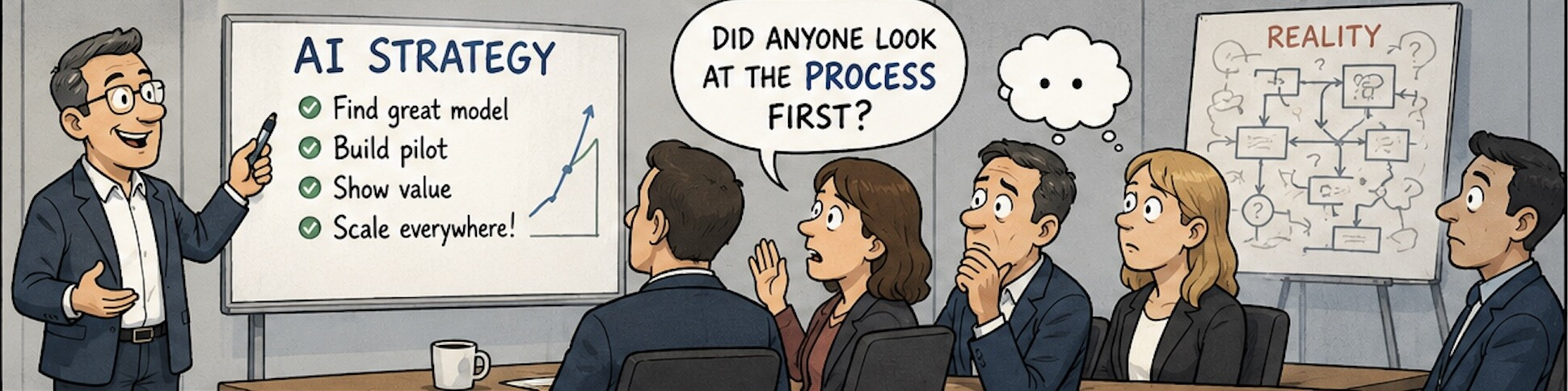
Over the past year, we have had many conversations with executives about artificial intelligence. Interestingly, very few begin with the work. Most begin with the technology. “We need (Agentic) AI.” Only then do the questions follow.
- “Where can we use it?”
- “Which processes should become autonomous?”
- “What can we automate?”
In many organizations, the decision to adopt AI has already been made before anyone has determined whether AI is actually the right solution. That’s understandable. AI has captured the imagination of every industry. But starting with the technology instead of the work often leads organizations to automate processes that should first be simplified, redesigned, or solved with deterministic software.
The better question isn’t – “Where can we use AI?” – it is – “What is the best way to perform this work?” Because AI not the only option. For every task inside an enterprise, there are three fundamentally different execution engines –
- Humans
- Deterministic software
- Artificial intelligence
The challenge isn’t choosing AI. The challenge is choosing the right engine – where exactly you use which engine.
We Have Been Here Before
For decades, enterprise technology focused on automating deterministic work. If a rule could be written, software could execute it – Calculate a premium, Post a payment, Validate a policy number, Reconcile a ledger etc.
Deterministic software excels when the answer must be exactly right every single time. Humans handled everything else – Judgment, Negotiation, Language, Ambiguity, Exceptions etc.
Now AI introduces a third capability. Machines that can reason through messy, unstructured information. That changes the equation.
AI Is Different
Unlike traditional software, AI isn’t deterministic. Ask the same question twice and you may receive slightly different answers. That makes many executives uncomfortable. It shouldn’t. Because many business activities don’t require perfect answers. They require useful ones – drafting emails, summarizing documents, classifying submissions, research, generating code – these are probabilistic tasks. “Usually right” is often enough because a human reviews the outcome. The mistake organizations make is trying to force AI into deterministic problems – pricing, tax calculations, payments, identity, access control, compliance decisions – these still belong to deterministic systems.
The Three Engines of Enterprise Work

3 Engines
Enterprise work as three execution engines.
Humans
- Best at – Judgment, Ethics, Relationships, Accountability, Novel situations
- Weaknesses – Slow, Expensive, Difficult to scale
Deterministic Software
- Best at – Rules, Mathematics, Repeatability, Compliance, High-volume processing
- Weaknesses – No context, No reasoning, Brittle when requirements change
AI
- Best at – Language, Pattern recognition, Classification, Summarization, Recommendations
- Weaknesses – Probabilistic, Can hallucinate, Requires grounding and guardrails
The objective isn’t replacing one with another. It’s routing every task to the least expensive execution engine that satisfies the required level of reliability. That’s a very different way of thinking about enterprise AI.
Some people call this the same idea by a different name: tokens, CPU, and humans. Three ways to get anything done, each with its own cost and reliability profile. The label doesn’t matter. The routing does. The objective isn’t replacing one with another. It’s routing every task to the least expensive execution engine that satisfies the required level of reliability. That’s a very different way of thinking about enterprise AI.

3 Ways
Most Processes Need All Three
Take an insurance submission.
- AI reads brokers emails
- AI classifies documents.
- AI extracts and summarizes information from unstructured submissions.
- Deterministic software validates required data, checks completeness, and performs appetite and pre-underwriting rules.
- A human underwriter evaluates the risk, applies judgment, and makes the final underwriting decision.
It’s intelligent orchestration – combining AI, deterministic software, and human judgment to optimize the end-to-end workflow.
Where AI Actually Fits Today
Zoom out across a typical enterprise and the same pattern holds, function by function.
- Sales and marketing – AI drafts outreach, summarizes calls, and does lead research. A person still owns the relationship. That’s assist, not autonomy.
- Back office and operations – document processing, data entry, pre-underwriting, call-center support. This is where AI does the most work, with a human still in the loop, and where the ROI is actually proven.
- Claims – AI triages intake, routes files, flags fraud signals. A person still makes the call.
- Finance – AI drafts narrative reporting and variance commentary. A person still signs off.
- Legal – AI drafts first-pass contract review and research. A lawyer still reviews.
- IT – AI generates code, tests, and documentation, and triages incidents. An engineer still owns what ships.
Same lens, applied everywhere – how much of the task can AI carry, and how much review does it actually need.
The Receipts
This isn’t just theory. The research backs it up, and it cuts both ways. The promise is real.
- Support agents using AI saw a 14% productivity gain, and 34% for novices (Brynjolfsson, Li & Raymond, QJE 2025).
- Developers using AI completed 26% more pull requests (Cui et al., 2025).
- Across writing, coding, and support tasks, teams saw 15 to 50% less time on task, with the biggest gains going to the least experienced people.
The reality is humbling. About 95% of enterprise GenAI pilots show no measurable P&L impact (MIT NANDA, State of AI in Business 2025). The barrier isn’t the technology, the budget, or the talent. It’s workflow integration, what researchers call the “learning gap.” More than half of AI budgets chase sales and marketing use cases, while the biggest ROI sits in the back office.
Both things are true at once. AI works remarkably well in narrow, well-scoped, human-reviewed settings. It quietly fails when organizations bolt it onto workflows nobody redesigned.
Why So Many AI Pilots Stall
The industry spends enormous energy discussing models – GPT, Claude, Gemini, Llama etc. That’s interesting. But it’s rarely the problem. Most failed AI initiatives didn’t fail because the model wasn’t good enough. They failed because nobody asked – is this an AI problem? Is this a software problem? Is this a process problem?

Why AI Pilots Stall
Sometimes the correct answer is – None of the above. The process itself should be redesigned before anyone automates it.
Patterns That Work
The organizations getting real value keep reusing the same handful of design patterns.
- Human-in-the-loop – AI drafts, a person reviews and approves before anything ships or commits.
- Retrieval and grounding – feed the model your own trusted data and cite sources, not just what it learned in training.
- Narrow scope – one job, clear inputs and outputs. Small, scoped tasks beat open-ended autonomy.
- Deterministic guardrails – wrap the probabilistic core in hard rules, validation, and limits.
Skip these, and even a good model turns into a stalled pilot.
Where Teams Get Burned
Whether observed in client conversations, industry research, or public case studies, these patterns appear again and again.
- Unbounded autonomy – add approval gates, and limit scope, tools, and permissions.
- No ground truth – define success metrics and a review baseline before launch.
- Hallucination on high-stakes paths – ground answers in trusted data, and keep a human on the final call.
- Pilots that never scale – integrate into the real workflow, and buy proven tools rather than DIY everything.
- Chasing the wrong ROI – target back-office automation first, where the returns are already proven.
A Better Starting Point
Before building an AI agent, every organization should ask six questions.
- Does the task tolerate a “usually right” answer, or must it be provably correct?
- Does someone review the outcome, or are errors cheap and reversible?
- Does the AI have access to sufficient business context and information to produce useful results?
- Could deterministic software solve this more cheaply and more reliably?
- Should the process itself be redesigned first before we automate it?
- If it works in a pilot, can it actually integrate into the real workflow at scale?
Those six questions eliminate enormous amounts of wasted investment.
From AI First Thinking to Work First Thinking
Successful AI adoption doesn’t begin by identifying where AI can be used. It begins by understanding the work. One that recognizes AI as one execution engine, not “the” execution engine. The future enterprise won’t ask – “Where can we use AI?”
It will ask – “For every piece of work, what is the best combination of humans, deterministic software, and AI?”
The organizations that answer that question well won’t simply deploy more AI. They will build better businesses.
Where Acxhange Comes In
Most organizations have already decided they need AI. What they haven’t done is reconcile what’s actually true about their own processes.
Every organization has three versions of every process: what the SOP says, what people say they do, and what the system and transaction data actually show. Those three rarely agree. And there’s a fourth, often-overlooked problem: many processes were built around the limits of legacy technology, constraints that may no longer exist. Sometimes the process itself is the workaround.
At Acxhange, we have developed StratWorks, a consulting framework designed to close that gap. Instead of starting with technology, we start with the work itself, reconciling documented processes, employee knowledge, and system data to understand how work actually gets done. From there, we classify every process step as Agentic, Deterministic, or Redesign, so you invest where AI creates real business value rather than simply following the latest trend.
If your organization has already decided it needs AI and is still working out what for, we would welcome the opportunity to compare notes. The goal isn’t to build more AI. It’s to build better ways of getting work done.