
Illustrations generated using ChatGPT (OpenAI)
Most insurers don’t need a model that knows insurance. They need a model that knows their insurance.
The same is true for banks, healthcare organizations. manufacturers…
Every enterprise has products, business rules, operating procedures, terminology, and decades of institutional knowledge that make it different from every other organization in its industry.
A general-purpose AI model understands the industry. It doesn’t understand your enterprise.
That distinction will become increasingly important as AI moves from experimentation into business-critical operations.
You are paying twice.
The cost of enterprise AI is usually measured in tokens. But that’s only half the story. You are paying twice.

Paying Twice
First, in tokens –
- Every claim summarized.
- Every underwriting submission reviewed.
- Every document extracted.
- Every API call.
Metered per interaction, repriced on someone else’s schedule. Everyone understands that cost.
Second, in compounding – and this one never reaches the invoice.
Reputable providers commit contractually not to train on enterprise data, and that commitment is worth having. But it doesn’t change the underlying arithmetic – nothing accumulates on your side.
Every correction your adjusters make, every prompt your team refines, every evaluation you run to prove an output is safe – all of it improves this quarter and leaves nothing behind. Year three looks like year one, minus the spend. And because every carrier is renting from the same handful of providers, whatever capability you gain, your competitors gain on identical terms. Differentiation that comes from a shared model isn’t differentiation. Meanwhile the things that actually separate you stay outside the model entirely –
- Your products
- Your underwriting philosophy
- Your claims handling practices
- Your policy forms
- Your operating procedures
- Your engineering standards
- Your enterprise terminology
A general-purpose model knows insurance. It doesn’t know your insurance – and no amount of prompting permanently teaches it, because nothing you teach it persists past the context window.
The organization that trains on those same interactions ends year three holding something: weights that encode how its people actually work, an evaluation suite calibrated to its own standards, and a pipeline that turns next year’s work into next year’s improvement.
That is the real second cost of renting. Not that someone takes your knowledge – that you never get to keep it. And every enterprise reaches the same realization eventually .. the closer AI gets to business-critical work, the more enterprise-specific knowledge matters.
What is a Sovereign Model?

Sovereign Model
The term “sovereign AI” is used in different ways. For the purpose of this article, a sovereign model isn’t simply an AI model running on-premises. It is an enterprise model built on an open-weight foundation model, then adapted, governed, and continuously evolved by the enterprise. That means –
- You choose the open-weight foundation model.
- The enterprise owns the model, adapters, and enterprise knowledge it builds.
- Your data remains under your control.
- It runs inside infrastructure you choose.
- It continues to operate regardless of any individual AI vendor.
Sovereignty isn’t about isolation. It’s about ownership. A simple test captures the idea. If your AI vendor disappeared tomorrow, what would your enterprise still own?
Frontier Models and Sovereign Models are complementary.
This isn’t an argument against frontier models. Quite the opposite. Frontier models continue to redefine what’s possible. They are exceptional for:
- Research
- Coding assistance
- General reasoning
- Knowledge discovery
- Creative work
Every enterprise should use them where they create value. But not every enterprise capability should depend entirely on models whose weights, pricing, roadmap, and availability are controlled elsewhere. General intelligence is becoming increasingly accessible. Enterprise knowledge never will.
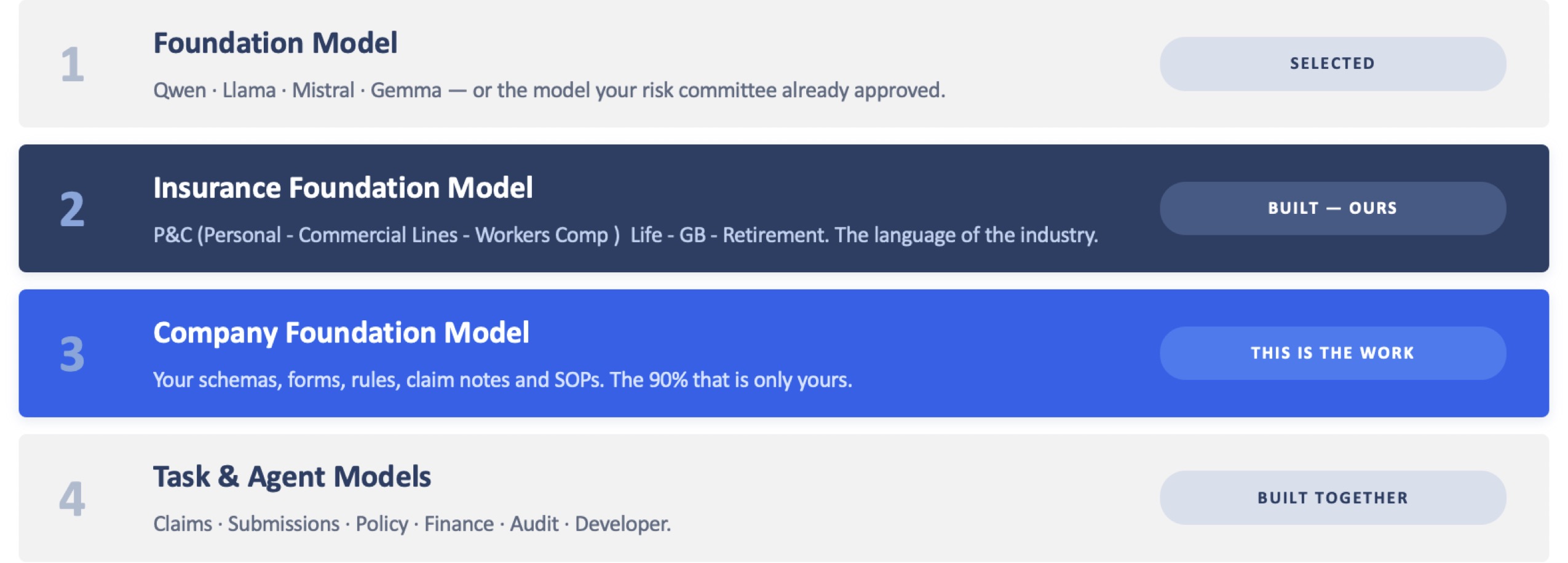
Enterprise AI is evolving into four layers.
Rather than thinking about “one model,” enterprises will increasingly think in layers.
Layer 1 – Open-weight Foundation Model
Start with an open-weight foundation such as Qwen, Llama, Mistral, Gemma, or another approved model. The objective is not to build a model from scratch. It is to start with one your enterprise can own and deploy.
One point of precision, you own the weights you train. You inherit the licence of the base model you started from, and those licences are not uniform – some are permissive, others carry attribution, usage or scale conditions that flow through to derivatives. Choosing a base model is a legal decision as much as a technical one, and it belongs at the start of a project rather than the end.
Layer 2 – Industry Foundation Model
Teach the language of the industry. Insurance / Banking / Healthcare / Manufacturing.
This layer captures the concepts every organization in that industry shares.
Layer 3 – Company Foundation Model
This is where competitive advantage lives.
- Your products.
- Your forms.
- Your terminology.
- Your underwriting rules.
- Your claims philosophy.
- Your operating procedures.
- Your engineering standards.
This is the layer that differentiates one carrier from another.
Sovereignty means being deliberate about what belongs inside the weights and what belongs around them. Two questions decide it.
How fast does it change? Your terminology, your house voice, your claims philosophy, your engineering conventions and the way your organization reasons about risk move on a scale of years. Train them. They should shape how the model thinks by default, which is something no amount of context-stuffing achieves. Your endorsement library, rate tables, form versions and desk procedures move on a scale of weeks. Train those and you’ve built something that is confidently wrong by next quarter.
Does it need to be provable? Some knowledge stays outside the weights even when it’s stable, because the answer has to cite a source. When an agent tells an insured what their policy covers, a regulator wants the form referenced, not a model recalling it. Retrieval isn’t only about freshness – it’s about producing an audit trail.
Train the judgment. Wire in the facts. A sovereign model isn’t one large artifact – it’s a stable trained core, surrounded by machinery that keeps it current and accountable.
Layer 4 – Business Agents (insurance example below)
Insurance examples –
- Underwriting — clearance, appetite screening, submission triage
- Policy operations — endorsements, form comparison, renewal review
- Claims — FNOL intake, coverage checks, file summarization
This is where enterprise specifics arrive at runtime. Agents retrieve the current form, read the live claim record, call the systems of record, and carry context across a transaction. The layers below supply vocabulary and judgment; this layer supplies today’s facts.
That inheritance is what separates an agent from a demo. An agent running on general-purpose intelligence begins every task as a stranger to your business, and spends its context being briefed. One built on the layers below starts already knowing how your organization reasons – and spends its context on the work.
The model isn’t the product.
The enterprise capability is. The objective isn’t to own AI for the sake of ownership. The objective is to own the intelligence that powers the business capabilities your enterprise depends on.
Most enterprises don’t own their policy administration, claims or billing platforms. They license them – and a decade of cloud migration moved them further from ownership, not closer. That was a reasonable trade. A system executes a process, and processes are largely common across an industry; there was never much advantage in owning the code that issues a policy.
A model is a different kind of thing. It doesn’t execute your process, it reproduces your judgment – how your underwriters read a submission, how your adjusters weigh a file, what your organization has learned to treat as normal. That judgment isn’t available from any vendor, because no vendor has it. It was built inside your own walls over decades, and it is now, for the first time, expressible as an asset.
Building sovereign models requires more than technology.
Owning a sovereign model is not simply downloading an open-weight model and fine-tuning it. It requires –
- identifying and preparing the right enterprise data
- building industry and company training datasets
- establishing evaluation benchmarks
- implementing governance and guardrails
- deploying models into enterprise infrastructure
- continuously retraining and monitoring them as the business evolves
In other words, building sovereign models requires a repeatable engineering capability – not just another AI project.
What this costs.
Sovereignty isn’t free, and an argument that pretends otherwise deserves suspicion. A model you own sits at a fixed capability level while frontier models improve past it. You take on the evaluation burden, the retraining cadence, the drift monitoring and the safety work a frontier vendor would otherwise absorb.
So the case isn’t “own everything.” For open-ended reasoning at the edge of what’s possible, renting is the right answer and likely always will be. Ownership earns its keep on the workloads that run constantly, touch your most sensitive data, depend on vocabulary only you use, and separate you from the carrier across the street. That is precisely where renting compounds against you.
Why we created SovereignWorks.
This is the thinking behind SovereignWorks.

SovereignWorks – The Sovereign Model Factory
SovereignWorks is not simply another AI platform or another hosted model. It is a Sovereign Model Factory – a combination of technology, people, and proven engineering processes that helps enterprises build, deploy, govern, and continuously evolve models they own.
SovereignWorks brings together three things – an industry foundation model, starting with insurance – already trained on the language of the industry, a pipeline that turns enterprise data into training sets and evaluation benchmarks, and a deployment and governance layer that runs inside the enterprise’s own environment. Organizations can leverage SovereignWorks to build sovereign models that remain under their control, evolve with their business, and operate within their own chosen environment.
The objective isn’t simply to deploy another AI solution. It is to help enterprises establish the capability to build models that become long-term strategic assets.
We spent twenty years learning that renting software was fine. It was — for systems. Models are where that logic breaks, because a model reflects the part of the business you could never have bought in the first place. The next decade of enterprise architecture will be less about owning the systems that run the business and more about owning the intelligence that reflects it. Frontier models will continue to play an essential role. But the business capabilities that differentiate an enterprise deserve something more – a model that understands its business, reflects its knowledge, and evolves with it.