

EvalWorks - Prove your AI agents work. To your board, and to your examiner.
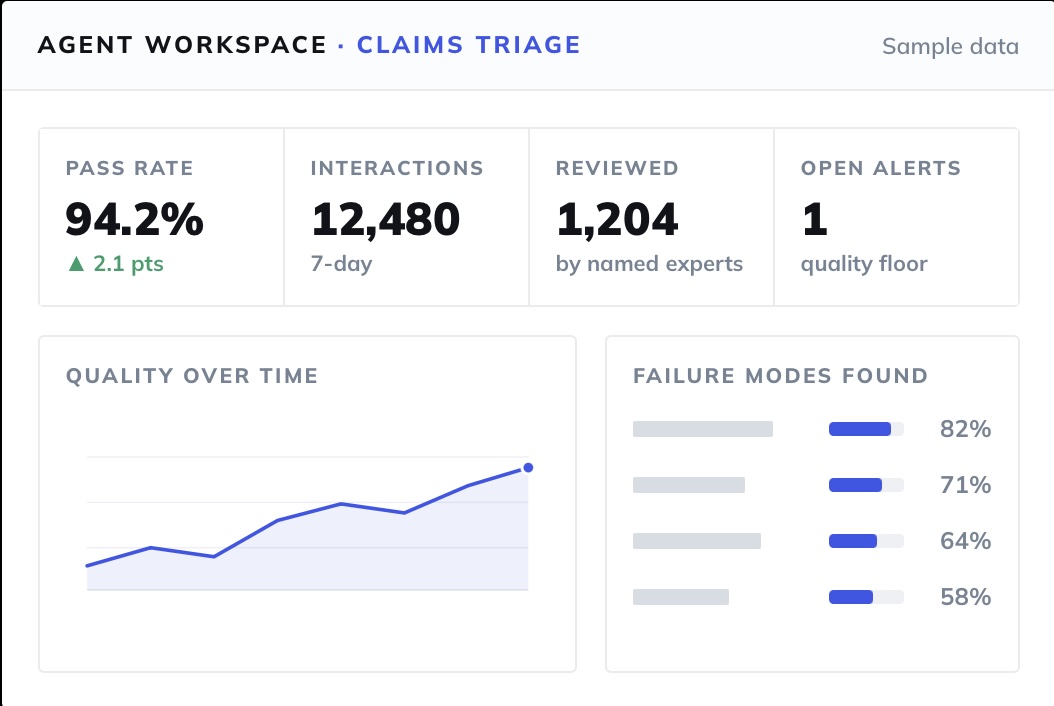
Getting an AI demo to work is easy. Keeping it working in production is hard. EvalWorks measures what your agents actually do, holds them to a standard you set, and turns the result into evidence a regulator will read. Built for banking and insurance. Deployed inside your perimeter. Yours to keep.
- Adversarial testing
- Single-tenant & self-hosted
- Continuous production monitoring
- Regulatory evidence, on demand

The demo passed. Nobody can tell you if production is passing.
Failures are silent.
AI agents can keep responding even when they are wrong—misreading a document, inventing a clause, or dropping critical information. Often, nothing fails technically.
“Good” isn’t defined.
Without shared evaluation criteria, quality becomes subjective and difficult to measure consistently.
Every change introduces risk.
Every change is a coin flip. A new model version, a reworded prompt, a document format that shifted last quarter — any of them can regress behavior you already paid for. With no eval suite in the pipeline, you find out in production.
The platform can’t independently grade itself.
Platform metrics don’t necessarily tell you whether the AI is making the right decisions for your data, workflows, and business.
Manual review doesn’t scale.
Spot checks aren’t assurance. Expert judgment needs to be captured, measured, and applied continuously
Why AI assurance isn't software QA
Traditional software is tested against expected behavior. AI agents operate in a world of probabilities, context and judgment.
An agent can produce a technically successful response that is still wrong, incomplete, ungrounded or inappropriate for the business context. And its behavior can change when the model, prompt, retrieved knowledge, tools, data or workflow changes.
That means quality isn’t simply pass or fail. It has to be measured across many real-world scenarios and over time.
What is Evaluation?
AI evaluation is the systematic measurement of whether an AI system is producing the right outcomes — reliably, consistently and within the expectations of the business.
It combines deterministic checks, business-defined rubrics, human judgment, aligned LLM judges, representative test data and production monitoring to answer questions such as: Is it accurate? Is it grounded? Did it use the right information? Did it take the right action? Is it improving or regressing? Can we trust it in production?
AI evaluation asks: Did it behave correctly — and can we prove it consistently?
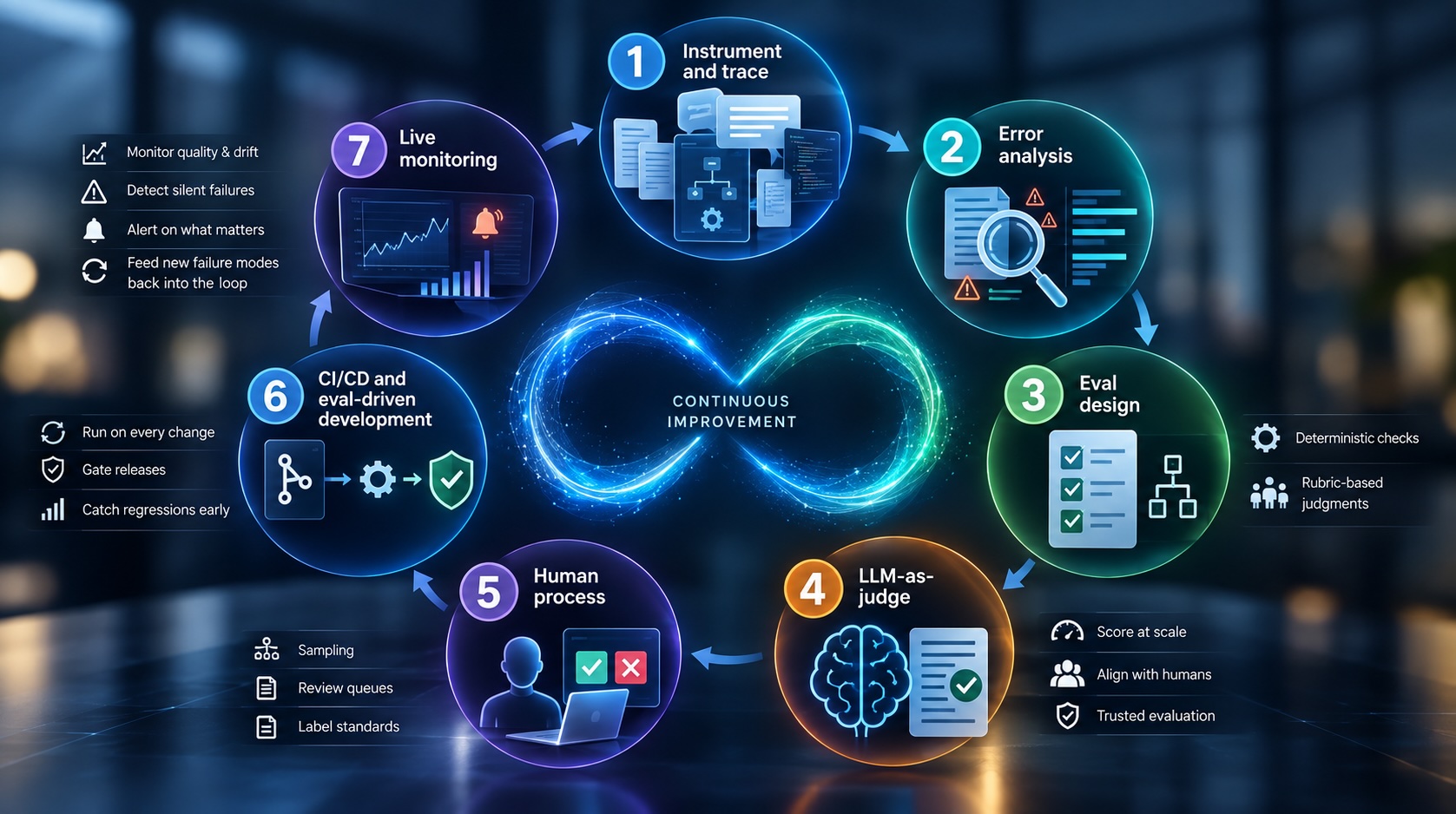
Seven stages, one loop ; Tech Solution + Consulting
A method that’s ours. Tooling that’s yours to choose.
The method — what doesn’t change Seven stages, one loop. It’s what makes evaluation tell you the truth, and it’s the same whatever it runs on.
The consulting — judgment you can’t install No tool decides what “good” means on your book. Our insurance SMEs and eval engineers read real failures with your underwriters and adjusters, turn disagreement into a written rubric, and align the judges until they match your experts.
The tooling — your call Run it on the Acxhange eval platform – “EvalWorks” for something working in weeks with insurance evaluators already built. Run it on your existing stack if you’ve standardized. Or run it on open source if you’d rather own every part. Same method either way, and we’ll tell you honestly which is cheapest for your situation.
Vendor-neutral is not a slogan here: we’re happy to be the tool, and equally happy not to be.
Grounding – is the extraction, classification or decision correct against ground truth?
Accuracy – is every claim traceable to the source document?
Hallucination – how often does it invent facts, citations or coverage
Regression – did this change break behavior that previously worked?
Business outcomes – cycle time, straight-through rate, referral quality, rework, cost per transaction.
| Level | What it looks like |
|---|---|
| L0 Ad hoc | Vibes and spot checks. No traces. |
| L1 Instrumented | You can see what happened, but not score it. |
| L2 Systematic | A real eval suite, run deliberately. |
| L3 Automated | Evals gate every change in CI/CD. |
| L4 Continuous | Production monitored, loop closed, drift caught. |
Most enterprise agents sit at L0–L1. EvalWorks moves you up the curve, and keeps you there.
Assessment to Implementation to operation.
Diagnostic — 2–3 weeks, fixed fee Eval maturity assessment, an error-analysis pilot on your real traffic, a failure-mode taxonomy, and a roadmap with quick wins.
Foundation — 6–10 weeks, milestone-based Tracing and data viewer stood up, evaluator suite built, LLM judges aligned to your experts, CI/CD eval harness wired into your pipeline.
Managed Evals — ongoing, retainer Production monitoring, continuous error analysis, judge and suite upkeep, regression gates held as your stack changes.
Advisory and enablement — flexible, workshops Strategy and governance, team training, playbooks and standards, org enablement.

What you get?
A shared, evidence-based definition of “good”, written down
A prioritized failure-mode taxonomy tied to business cost
An automated eval suite and aligned judges, running in the tooling you chose
CI/CD gates that catch regressions before release
Production monitoring of silent failures
A team equipped to run all of it after we leave — no lock-in to us or to a tool
Who it is for?
Carriers, MGAs and brokers running AI in underwriting, submission intake, policy operations or claims — whether you built it, bought it, or inherited it. EvalWorks is vendor-neutral and works on any stack, including agents you did not build with us.
Don't take the demo's word for it.
Start with a 2–3 week Diagnostic. You’ll get a failure-mode taxonomy from your own traffic and a clear view of what to fix first.
Get in Touch
We're here to answer all your queries. Reach out to us to accelerate your business